

UMD J school prepares journalists, and more
By Karen Hott, September 2026
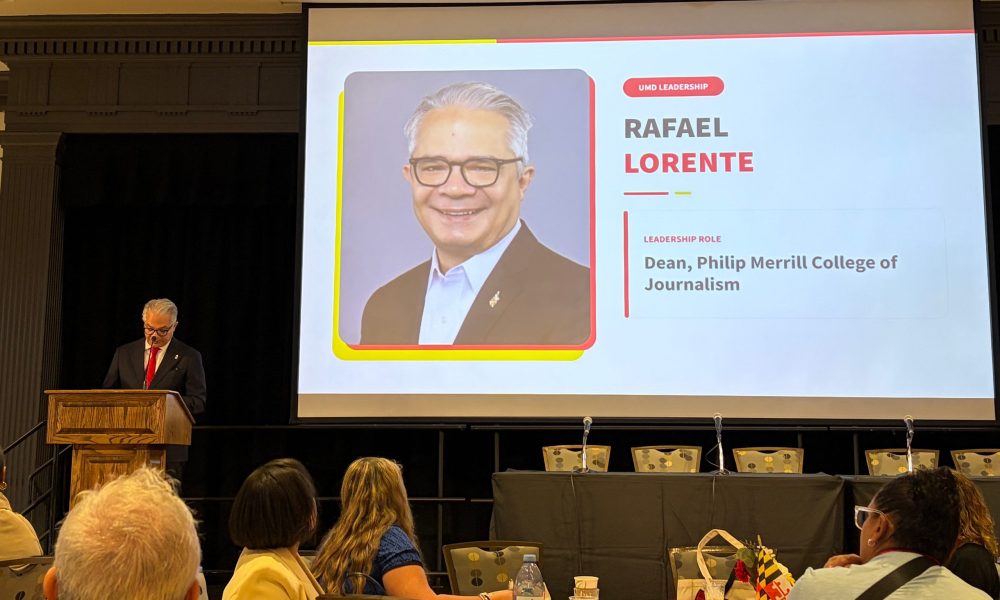
Is journalism dying? No, said Rafael Lorente, dean of the Philip Merrill College of Journalism at UMD, speaking to about 200 counselors at UMD Counselors Day on Sept. 23, 2026. Without the Fourth Estate, “who will tell the stories that help citizens make decisions and hold power accountable?” Journalism, he said, needs to build a better information system and a sustainable business model in the fast-changing world of information delivery.
Not just for future journalists
Journalism can be an excellent major for students interested in law, government, policy, even sports and business. It teaches you how to make sense of data, how to ask important questions, how to sort and synthesize information. It’s inquiry-based learning. Good questions create good stories, but also good thinkers.
The journalism degree at UMD incorporates data analysis, data visualization, visual and production skills, critical thinking and more. Journalists no longer focus on one area, like print or broadcast, but prepare to deliver news on multiple platforms. According to the college’s website, merrill.umd.edu, the Merrill College “is the leader in data journalism, audience analysis, and exploring how to use AI and other modern tools for good.” At the core of all journalism, though, lies the skill of writing, and writing is the key to telling stories.
The Merrill College of Journalism accepts about 70 to 75 students a year and is ranked in the top five by multiple services. Journalism was once a Limited Enrollment Program (LEP), but with more faculty and more space, it is no longer an LEP. The college still keeps its incoming class small. Lorente said, “We want students who want to solve problems and puzzles.”
Experience from the first semester
“J School at UMD has one of the most experiential curriculums in the nation,” Lorente said. In fact, you can’t graduate without a byline to your name, and they require you to do an internship. A full-time coordinator helps students arrange internships. Maryland’s proximity to Washington, D.C., brings students close to important news outlets in the nation’s capital.
Real-world experiences begin with your first semester. Students can report from Baltimore, D.C., Annapolis and College Park with Capital News Service. They can investigate important issues through the Howard Center for Investigative Journalism, and dig into sports through the Shirley Povich Center for Sports Journalism.
Have you seen Pete Muntean (photo below) reporting about air travel on CNN? The CNN aviation and transportation correspondent is a graduate of UMD’s Merrill College — and a former newspaper staffer of mine on the Broadneck High School Tribruin.

Seven faculty members have won Pulitzer or Peabody awards.
The University of Maryland has 10 student-run independent media outlets, including the daily print and online Diamondback and WMUC radio, so in addition to being close to D.C. and Maryland’s state capital, Annapolis, there are plenty of opportunities to earn that byline.
Journalism is changing
Is journalism dying? Not at Maryland. It’s changing, and the students who thrive at Merrill are the ones who like solving puzzles, asking the next question and turning piles of information into something people can use. Whether they end up in a newsroom, a law office, a campaign or elsewhere, their bylines show they can find the story and tell it well.