

UMD First-Year Invitation Programs create community
By Karen Hott, September 2026
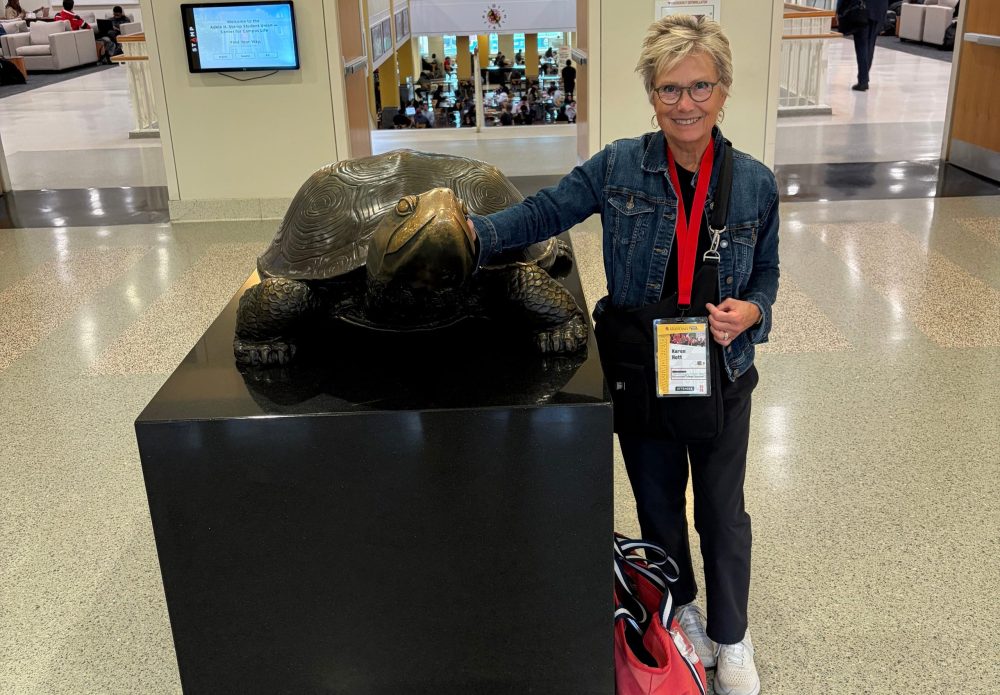
UMD is big
The University of Maryland, with 31,000 undergraduates, is a big, big school. To help freshmen transition to the university, UMD offers five different first-year invitational programs: Honors, Scholars, FIRE, BioFIRE, and Carillon.
You’ll discover your invitation to one of these programs when you open your acceptance letter—you’ll only be invited to one, if you’re invited at all. Merit aid is separate from special-program participation. A little-known fact: you can nominate yourself to a program if you aren’t invited. Do this after you receive acceptance to UMD and before matriculation, by emailing admissions and letting them know you’re interested.
Maryland does not require test scores for admission or for these programs. All students who apply by November 1 are automatically considered, so make sure your application and all materials are in to UMD by that date. (For the Class of 2030, 93 percent applied by then.) Representatives of the programs, including the students on the panel, say that if you’re invited, you should accept.
Your application should show passion, but don’t count on admissions reading an uploaded résumé. Use all the spaces given you on the Common App—activities, personal essay, and the short-answer questions—to show who you are and what you care about.
By the numbers
- 67,000 total applicants to UMD for a freshman class of 5,500
- Honors College: ~3,300 invited (under 5 percent of applicants), to a cohort of under 1,000
- College Park Scholars: ~4,000 invited, to a cohort of about 1,000
- FIRE/BioFIRE: 2,000+ offered a spot, for a combined cohort of 550
- Invitations run about 40 percent out-of-state, but enrollment ends up around 90 percent in-state, since out-of-state yield is lower
Honors College
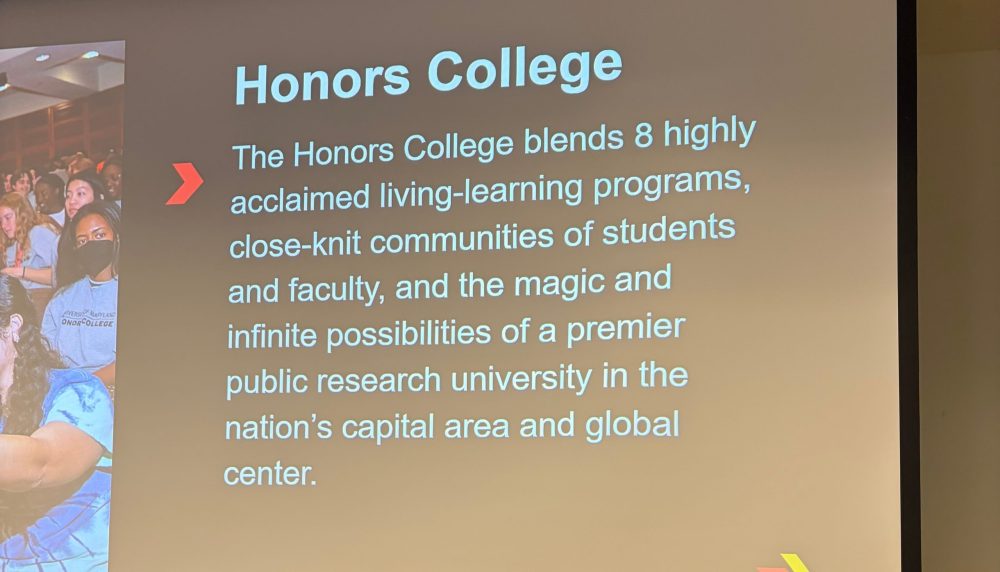
Invitees to the Honors College are the most academically accomplished students in the applicant pool. Consider the middle 50 percent SAT scores of Honors College students who submitted scores: 1470 to 1540; out-of-state students should aim for the top of that range (34–35 ACT). You don’t have to submit test scores, though—about half of those admitted to UMD don’t. If you do report scores, they should be within or above the middle-50 range.
Once admitted to Honors, you select one of eight programs. Your track doesn’t have to align with your major, though it can.
Require living on campus:
- Advanced Cybersecurity Experience for Students (ACES, two years)
- Gemstone (four-year research program)
- University Honors
Open to commuters:
- Design Cultures & Creativity
- Honors Global Challenges and Solutions
- Honors Humanities
- Integrated Life Sciences
- Interdisciplinary Business Honors
You’ll turn in a ranked list of preferences before matriculation. With two years in the Honors College, you’ll receive the Honors College mark alongside your major on your diploma. honors.umd.edu
College Park Scholars
This two-year program for academically talented students looks at your activities outside the classroom and your interest in interdisciplinary learning. You select one of 13 thematic programs for hands-on learning within an interdisciplinary curriculum, with faculty mentorship and internship and research opportunities. Your sophomore year involves a practicum, such as an internship or study abroad. Scholars live in the Cambridge community dorms (one of which is still not air-conditioned!), but commuters can participate too. There’s a field trip each semester; one recent outing visited the Chesapeake Bay Foundation headquarters in Annapolis.
About 75 students enroll in each Scholars program, and since Scholars students have shown interests in multiple disciplines, it’s not uncommon to find a business student in Arts or a journalist in Data Justice. The 13 programs:
Arts · Business, Society and Entrepreneurship · Civic Engagement for Social Good · Data Justice · Environment, Technology and Economy · Global Public Health · International Studies · Justice and Legal Thought · Life Sciences · Media, Self and Society · Public Leadership · Science and Global Change · Science, Technology and Society
FIRE: First-Year Innovation and Research Experience
FIRE is a three-semester program involving faculty-mentored research in natural sciences, social sciences, humanities, and technology. Classes meet once a week, and peers then meet separately for four to six hours of lab or laptop research during the week. FIRE seeks students interested in research who have demonstrated resilience. The program runs 16 different “research streams,” such as Bacterial Pathogenesis, Gene Silencing, Music & Social Identity, Visualizing Social Justice, and Quantum Machine Learning.
Though FIRE students build their own community, it isn’t a living-learning program. Commuters and Freshman Connection students may be invited. Of the 550-student cohort, 40 spots go to Freshman Connection students; this year, those 40 spots filled in 24 hours. fire.umd.edu
BioFIRE
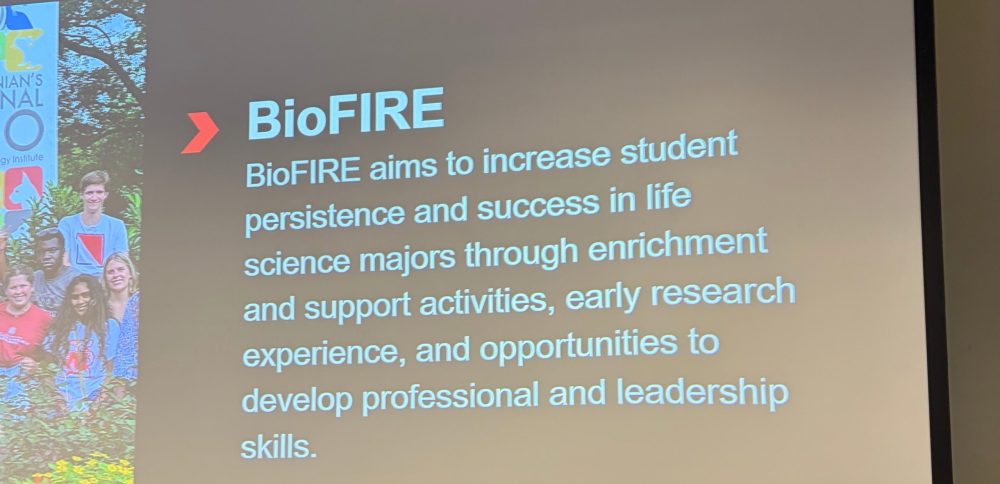
As the name implies, BioFIRE is a subset of FIRE focused on research in the life sciences. Its goal is to “increase student persistence and success in life science majors through enrichment and support activities, early research experience, and opportunities to develop professional and leadership skills.”
Unlike FIRE, BioFIRE is a living-learning community. You take foundational science courses with other BioFIRE students and live in Somerset Hall, though commuters are welcome. You’ll work in faculty labs in association with FIRE and take part in study groups, tutoring, field trips, lectures, and social activities. A for-credit seminar explores strategies for biology, biochemistry, chemistry, and neuroscience majors to successfully transition to the next level of college or career. cmns.umd.edu/undergraduate/future-students/biofire
Carillon Communities
Carillon is a living-learning community for curious students who want to solve problems creatively and through teamwork. You can choose one of three communities: Constitutional Rights, Health Justice, or iGive. The iGive class identifies a social cause and a local organization to donate $7500 to. carillon.umd.edu
Worth noting: Carillon was significantly scaled back starting the 2025–26 academic year, from 13 communities and about 375 students down to just 3 communities and about 130 students. That downsizing may explain why, unlike the other four programs, Carillon didn’t have a representative on hand at Counselor Day.
The last word
No matter which program your student lands in—or whether they self-nominate for one after acceptance—the point of all five is the same: to shrink a 31,000-student university down to a size where a first-year can find their people fast. If your student is invited, take it seriously and say yes. And if an invitation doesn’t come, that’s not a verdict on their file; it just means their path to community at Maryland will look a little different, and just as real.
I gathered these details at a session on First-Year Invitational Programs at the UMD Counselors Day on September 23, 2026. Thanks to Maryland admissions for organizing these events every two years!