

How I approach the Common App essay
By Karen Hott, August 2026
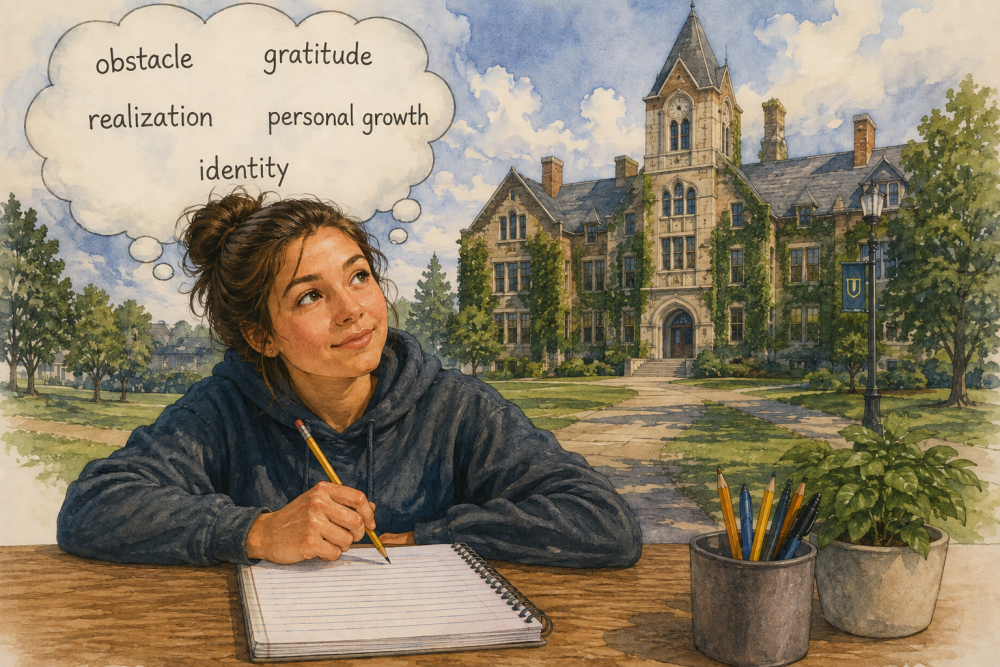
Lots has changed in college admissions since I wrote a brochure 10 years ago called “Tips for Writing College Application Essays,” but the instructions for the Common App essay are word-for-word the same:
The essay demonstrates your ability to write clearly and concisely on a selected topic and helps you distinguish yourself in your own voice. What do you want the readers of your application to know about you apart from courses, grades, and test scores? Choose the option that best helps you answer that question and write an essay of no more than 650 words, using the prompt to inspire and structure your response.
Common App tells you exactly what the essay should do. It should show you can “write clearly and concisely on a selected topic” and “distinguish yourself in your own voice.” Who are you beyond the numbers? What kind of self will you contribute to campus?
My approach
As a former AP English Language and Composition teacher and newspaper adviser, I spent decades teaching students to write better. Sometimes that better writing starts with loosening up your brain, like stretching your muscles before a workout. Rather than ask my students to pick a prompt, I start with some warm-up exercises I’ve adopted and adapted from Ethan Sawyer, the College Essay Guy, such as the “Essence Objects,” “Values,” and “Roles and Identities” exercises.
Get a tattoo
To get them thinking about their values, I ask them to get four or five “tattoos,” where each tattoo represents something important to them on a literal and figurative level. If I were to get a tattoo myself, I’d get a sailboat. Literally, I love to sail, to move through water capturing the energy of the wind; figuratively, I go by the philosophy that though I can’t change the wind, I can adjust my sails.
I’d also get three baby turtles scuttling toward the Gulf in the moonlight, a pair of garden clippers, and two ospreys on a nest. I tell my students what these mean to me on several levels. Besides wanting to preserve endangered species, gardening, and having a pretty good osprey call, I identify with those turtles drawn to the unknown, I’m really good at helping students prune excess words, and like the ospreys, though I fly south regularly, I always come home to Maryland.
After we’ve done warm-up exercises, we analyze and brainstorm for each prompt. Here’s a breakdown of the first prompt:
Prompt 1
Some students have a background, identity, interest, or talent that is so meaningful they believe their application would be incomplete without it. If this sounds like you, then please share your story.
background: I used to envy people with clear ethnic backgrounds until I realized that I have a unique background: my father was from a little town in West Virginia and my mother grew up in the city of Washington. That means that I grew up going to museums in D.C. and swinging across the creek on grape vines in West Virginia. Think about how your parents’ backgrounds have influenced your life. Think about how where you’ve grown up has affected who you’ve become.
identity: Identity seems to stump a lot of students. It’s like the fish asking what water is. Are you an athlete? a musician? a big sister? I identify as a mother, wife, and teacher, but also as a writer and counselor. Refer to Ethan Sawyer’s “roles and identities” exercise that you did in the warm-up phase for ideas.
interest: Look at your “tattoos” to see if any of these represent a keen interest of yours. I’m interested in sailing and preserving the environment. Think about something that you do that shows your interest.
talent: A musician, an athlete, a ballerina. These people have obvious talents. But look at your roles and identities. Are you a talented listener? Do people seek you out to tell you their problems? Are you a problem-solver? Are you the one who figures out what to do when the 20-foot-high castle wall of your play breaks just before opening night?
From there, we analyze the second, third, fourth, fifth, and sixth prompts, breaking each prompt down into its component parts.
Prompt 2
The lessons we take from obstacles we encounter can be fundamental to later success. Recount a time when you faced a challenge, setback, or failure. How did it affect you, and what did you learn from the experience?
For this question, which 23 percent of students chose in the 2025-26 cycle, I ask students to consider the gradations of meaning in obstacles, challenge, setback, and failure. The words share the implication that each is something you have to get over or past to experience success. Think about obstacles, challenges, setbacks, and failures. Did you try out for a team and not make it? How did you feel? What did you do? What did you learn?
Prompt 3
Reflect on a time when you questioned or challenged a belief or idea. What prompted your thinking? What was the outcome?
Very few people select this question. Because it’s hard! Think about assumptions at school or at home. Did you work through SGA to change a policy at school? What was the belief behind the policy? Have you questioned your own beliefs? Perhaps you’ve had a realization that something you believed to be true wasn’t really that simple. How has this changed how you interact with others?
Prompt 4
Reflect on something that someone has done for you that has made you happy or thankful in a surprising way. How has this gratitude affected or motivated you?
This is another tough question, and for that reason few people choose to answer it. Be careful not to turn this into a paean to someone else. The bulk of the response should be about how gratitude affected you, or even better, motivated you to do something positive.
Prompt 5
Discuss an accomplishment, event, or realization that sparked a period of personal growth and a new understanding of yourself or others.
About a fifth of all respondents opt for this question. I think that’s because high school students, especially juniors, experience so much personal growth. I start at the end: What do you understand about yourself or others today that you didn’t understand before? That’s personal growth. For some people, the new understanding is sudden, sparked by an event or accomplishment, but for others, the realization comes gradually. Remember that readers are trying to figure out how you’ll fit into their campus tapestry. Who is this maturing person?
Prompt 6
Describe a topic, idea, or concept you find so engaging that it makes you lose all track of time. Why does it captivate you? What or who do you turn to when you want to learn more?
Only 5 percent chose this prompt, but it sets you up to showcase your intellectual curiosity. I wouldn’t suggest writing about a video game even if you do lose track of time playing Fortnite. That isn’t likely to show how your mind works. Do you explore topics/ideas/concepts beyond what you learn in school? Do you go down rabbit holes? Admission readers like to read about people who pursue an independent education in some area. Are you fascinated by clouds? Why? Do you know all their scientific names and profiles? How did you learn about them?
Prompt 7
Share an essay on any topic of your choice. It can be one you’ve already written, one that responds to a different prompt, or one of your own design.
Something like 28 percent choose to submit an essay that fits this category, but I don’t recommend it. One, it’s easy to pick an English paper or some creative writing you did, and that’s not likely to show the readers who you are beyond your transcript and test scores. Common App very deliberately crafted the six prompts above to get at who you are. They aren’t looking for a literary analysis or a poem you wrote about teen heartbreak.
Now you can pick a prompt
Once we’ve brainstormed the six main prompts, I ask students to look for two things: themes or stories that keep surfacing no matter which prompt they’ve written notes for, and which prompt got them writing the most. If one prompt jumps out as the one, go for it. But if you found a theme instead, match it to the prompt most likely to let you tell the full story.
Finally, a word about that voice. If you turn your essay over to AI, if you allow Mom to get into your document and “fix” it, your voice will disappear. I once had a student share her essay with her entire English class! The essay is not a group project. It is your chance to give the admission readers insight into your unique personality and passions.
Some tips
Write the middle first: Don’t worry about the beginning or end. In newspaper, my reporters often got stuck on what their lead (lede) should be, but if they just went ahead and wrote the rest of the story, a great lead sometimes showed up in the middle. You might find your “hook” as you write. As for the ending, please don’t fall back on that eighth-grade conclusion (“As you can see. . .”). I like essays that come full circle, somehow tying the ending back to the beginning, but don’t force it.
Read it aloud!: Reading your essay aloud can help you tell if it sounds like you or a robot or a 45-year-old mom. You’ll hear whether you’ve got a beginning that invites the reader in. It will also tell you if the essay feels complete at the end.
Tell a story: These prompts naturally lend themselves to the narrative form. Spend less time on what happened and more time on who you became because of it.
Be authentic: If there’s one recommendation I’ve heard from every admissions presentation I’ve attended, it’s that they want “authenticity” in your application essay.
The world changed. The assignment didn’t.
When I wrote that brochure ten years ago, it was before COVID, before the test-optional movement, before application inflation whittled admit rates to splinter size. Through it all, the essay hasn’t changed what it’s asking for: clear writing, in your voice, and a glimpse of who you are beyond the numbers.