

Earlham’s values weave a very close community
By Karen Hott, April 2026
Fast facts for
Earlham College
Located in:
Richmond, IN
Number of students:
670 undergraduate
Acceptance rate:
73% of applicants
Type:
Private, religious affiliation
Affiliation:
Quaker
Test Policy:
Test Optional
This blog post is about a specific college or university, so we've included some key details right up top. These facts were last updated April 19, 2026.
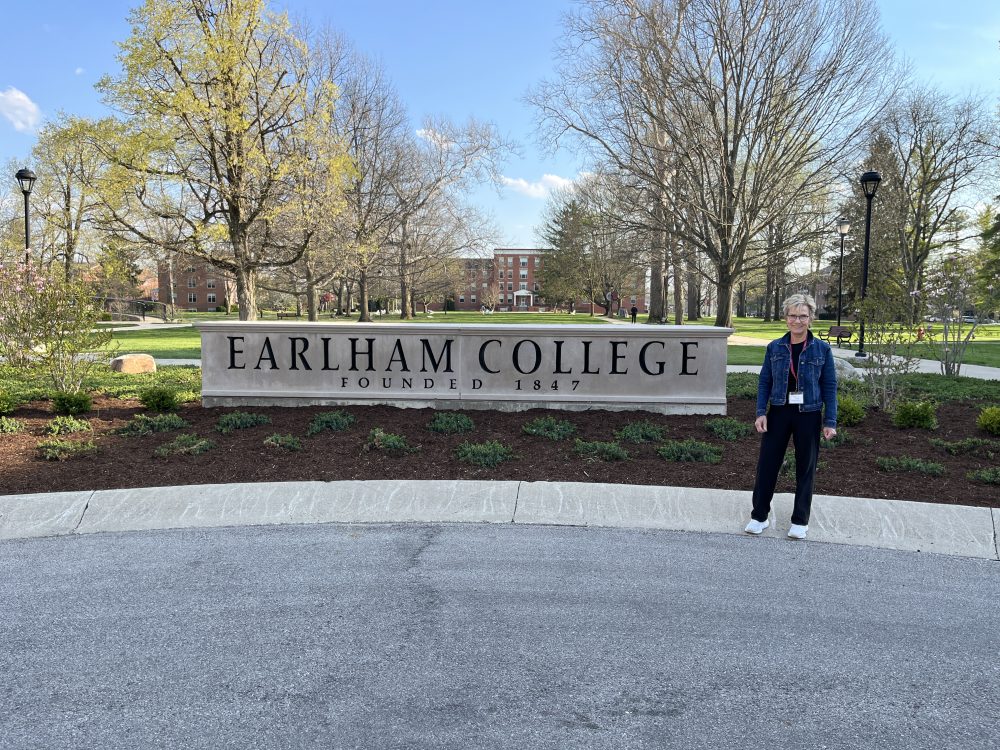
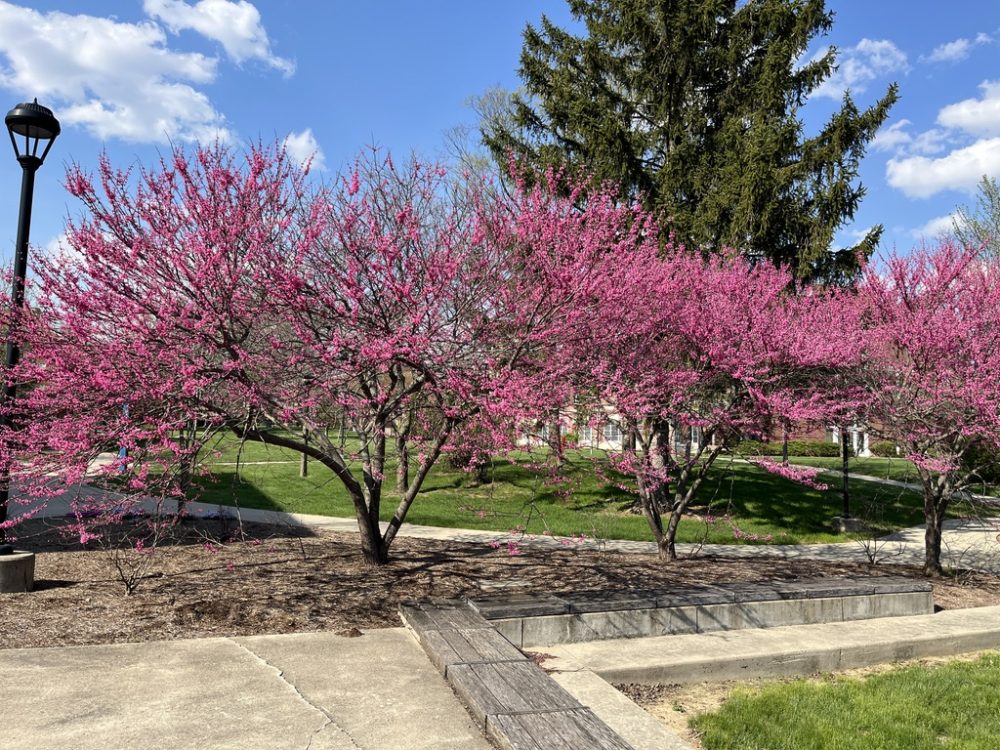
I visited Earlham College in Richmond, Indiana, over two fresh spring days in April as part of a counselor fly-in event. The redbud trees were in full dark-pink bloom and the oaks were just leafing out.
If you really want to be seen for who you are, to have support to lift you to your highest potential, and to have a solid liberal arts education that prepares you to launch into a career, Earlham College may be for you.
Only 10 to 15 percent of the faculty, staff, and the 670 undergraduates practice the Quaker religion, but Earlham College, founded in 1847, takes its Quaker roots seriously. Their team is even called the Quakers (though the unofficial mascot is a red fox squirrel).

Earlham’s mantra
The mantra “Respect for Persons, Integrity, Peace and Justice, Simplicity, Community” is stenciled on walls and into the school’s ethos. Earlham notes that these values are equally important, and that the order doesn’t imply a hierarchy.
Respect for Persons
Because Quakers believe all persons are equal in their access to inner truth, the Earlham community commits to the intellectual, physical, and emotional well-being of everyone. They reject “coercive and destructive behavior in interpersonal relationships.” Addressing each other by first name marks this respect.
Integrity
Integrity means speaking truth even when it is difficult and recognizing your own conscious and unconscious biases. The counselors on this counselor fly-in event applauded the transparency of the professors and administrators, who answered our questions frankly.
Peace and Justice
There’s a Student Activism and Social Justice timeline that shows Earlham’s pursuit of social justice that goes back to WWII, when they took in Japanese students who faced internment from the U.S. government. Earlham offers a major in Peace and Social Justice.
Simplicity
Simplicity isn’t about deprivation—it’s understanding what’s essential and what isn’t. There’s no Greek life, with its hierarchy and exclusivity. Theme houses are open to all. Sustainability is a core value here because simplicity rejects excess.
Community
This may be the most salient feature of Earlham College. The community embraces everyone, the students, the faculty, the staff. The safety officer sponsors the radio station and mentors students. Everyone addresses the president as Paul. Faculty and staff make decisions together through consensus. You will be seen and accepted here. The four-year residential requirement means commitment to this community through senior year.

Athletics
About half the students at Earlham play DIII varsity sports, and a good number play intramural and club sports, but you don’t have to be an athlete to thrive here. There’s no football, but soccer and basketball, baseball and softball, as well as women’s volleyball, are some of the 17 varsity sports.
Study abroad
Earlham is #4 in the nation for percentage of students who go abroad. Across all U.S. universities and colleges, an average of 12 percent study abroad, but at Earlham, it’s 65 to 70 percent.
First-year experience
Students meet every Friday with their adviser and cohort. A composition class is required. In the seventh week of the fall semester, Earlham proactively offers additional tutorial support—as they’ve seen that often, the students who need the most help don’t seek it. First-generation students have access to LIFT, a program that matches them to a personal research librarian and uncovers some of the “silent curriculum” or implicit lessons that first-gen students may not know.
Academics
Cross-disciplinary projects are encouraged and easy to pursue. This cross-disciplinary tradition extends to faculty: the business professor talks regularly with the theater professor. No siloes here.
Notable programs
Peace and Global Studies: This is a major for activists in community organizing, climate change, human rights, and more.
Neuroscience: Neuroscience combines biology and psychology to study emotion, behavior, and psychiatric diseases.
Theatre Arts: Students create original shows and take them to the Scotland Fringe Festival each year; 73 percent of graduates secure theater-related jobs.
Japanese Studies: Earlham has been a leader in Japanese Studies for 50 years. It involves learning the language and understanding the culture. Japanese Studies majors and nonmajors can spend a semester or a year immersed in the culture of Japan.
Anthrozoology: An applied minor, the study of human-animal interaction is a popular addition for students interested in veterinary school.
Center for Global Health: Earlham graduates have a medical school acceptance rate of 82 to 86 percent, twice the national average. They attribute the success to dedicated pre-health advising, a strong natural sciences curriculum (including a human cadaver lab), and experiential learning.
The EPIC Program
Earlham’s EPIC program ensures that every student graduates with what they call a “professional calling card”—a four-year arc that moves from early life-design coaching through career-ready credentials to a signature story the student owns. The $5,000 Epic Advantage grant funds a career-discerning experience for every student before graduation. What that looks like in practice: Classics faculty leading students on a 90-mile hike of Hadrian’s Wall, conducting independent research along the way. A student athlete heading to Malaysia to work on sea turtle conservation. Business students connecting with entrepreneurs in developing countries through Bankers Without Borders. Parents worried about return on investment should find the EPIC framework reassuring—Earlham takes the liberal arts seriously and takes life after graduation equally seriously.

Money
Earlham is test optional, and that goes for scholarship consideration. They award merit aid up to $40,000 when you submit your application by November 1. There’s a $1 million fund available for learning a new skill. One of the students on the panel used this scholarship to learn to play piano. Earlham also offers discipline-specific scholarships in areas such as art, music, Quaker Fellows, honors, creative writing, but you must apply for these by December 1.
I applaud Earlham for this: You will get your financial aid letter when you get your acceptance letter. No waiting for April to know whether the financial package will make Earlham feasible or not.
Honesty
Staff and faculty were frank with counselors about the challenges Earlham faces. New president Paul Sniegowski inherited a longstanding budget shortfall and made significant changes, cutting about 40 percent of academic programs. International enrollment is down, resulting from visa challenges. But Earlham wants to increase their undergraduate population to 1,000 from its current 670, and this should help their financial profile.
Who thrives here?
The student who wants to be known by and to know their professors as real people will thrive here. The athlete who wants to play DIII sports and still have an intimate academic experience will thrive here. The B+ students who, with some attention and nurturing, can become truer and better versions of themselves will thrive here. The student who wants the intimacy of small, discussion-based classes, who doesn’t want to be just a name on a roster will thrive here.
Who would not do well at Earlham?
If you refuse to consider a school that’s smaller than your high school, you won’t consider Earlham. If you crave the rah-rah of joining 90,000 other screaming fans in a legendary football stadium, Earlham’s not for you. If you want to remain anonymous and just get through your courses to get the degree, then Earlham’s not for you.
Worth a look
Families should be aware of Earlham’s challenges, but also look at its strengths: a solid career-aware plan grounded in strong liberal arts, unalloyed acceptance of all who go there, and a community of staff, faculty, and students whose sheer enthusiasm for Earlham could positively lift it up.