

Loyola Chicago puts values into action
By Karen Hott, April 2026
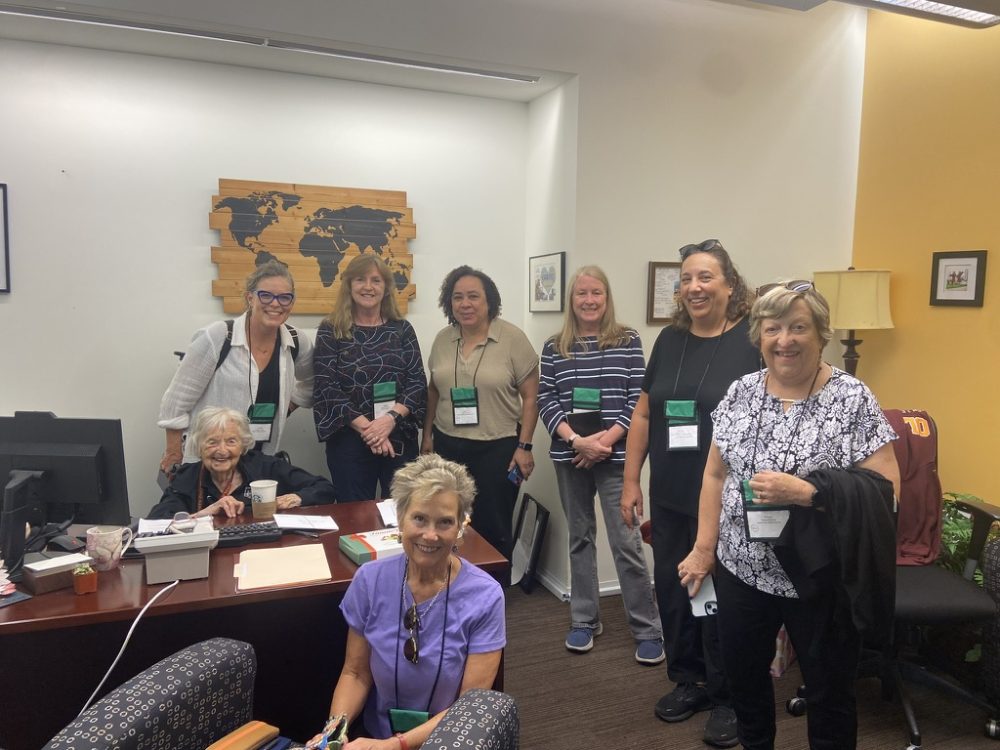
I met Sister Jean!
In October 2023, I met Sister Jean, the then-104-year-old nun of Loyola who became a video sensation as the men’s basketball chaplain rooting for the Ramblers courtside in the 2018 playoffs. She has an office in the student center with an open door, through which seven college advisers and I walked to say hello and snap a group photo. Sister Jean died on October 9, 2025, at the age of 106.
Two campuses, one university
Loyola comprises two campuses about a 15-minute ride apart: the Water Tower location in the center of downtown Chicago and the Lake Shore location, literally on the shore of Lake Michigan. Most housing is on the Lake Shore campus, but there is one downtown residence hall for those in business, communications, education, or social work. A LUC bus shuttles students between campuses. Housing is required and guaranteed for the first two years.
On the Water Tower campus, you’ll find the Quinlan School of Business, the School of Education, the School of Social Work, and the School of Communication. The law school is also downtown.
On the Lake Shore campus, you’ll find the College of Arts and Sciences (the largest LUC college), the School of Nursing, most graduate schools, and the School of Environmental Sustainability. That’s where I geeked out. A whole school devoted to sustainability! YES!
Sustainability in action
Within the School of Sustainability is the Biodiesel Lab, a student-run enterprise that converts cooking oil from the school’s kitchens to biodiesel fuel. In an effort to become a zero-waste facility, they learned that with a little tweaking, they could make soap as a by-product of the fuel. They sell the fuel and soap to Loyola University Chicago and sustain themselves financially through those sales. Zach Waikman, who manages the program, said in 2023 that their goal of net carbon neutrality by 2025 was in reach. Loyola announced that it had reached its goal of net carbon neutrality in December 2024. All energy they use is purchased from renewables, the largest being solar.
Learning by doing
Experiential education takes the form of “engaged learning” credits. The Biodiesel Lab provides paid research opportunities, but the engaged learning that takes place through Inigo appealed to me. Inigo, established in 2017, is a student-run communications agency providing assistance in social media, websites, video production, and advertising. As a former high school newspaper adviser, I’ve heard from so many former students that they learned more producing that paper than in any single class. Students in Inigo bear the responsibility of meeting client demands, creating products, meeting deadlines, and staying financially viable. (Update 4/18/26: Inigo is still running!)
Academics and admissions
The Jesuit commitment to learning by doing that animates the Biodiesel Lab and Inigo runs through every dimension of a Loyola education — from its robust core curriculum to the way it structures students’ paths to graduation.
Loyola admits directly to major, but with the exception of nursing, switching majors isn’t a problem. Nursing enrolls 220 students each year, retaining 90% and boasting a pass rate at the same level. Loyola medical students mentor pre-health students.
An ABET-certified engineering program offers biomedical, environmental, and computer engineering to a small cohort of students.
Jesuit identity
Loyola University Chicago is a Jesuit school with about 50 percent of students identifying themselves as Catholic. While it does have a beautiful art deco church as a centerpiece beside Lake Michigan, it doesn’t have the same stamp of religion that you find at The Catholic University of America in Washington, D.C. It has a two-course religion requirement that invites exploration of different avenues of religious thought. The Jesuit ethos of social justice and giving back to others permeates the university.
The core curriculum
Core requirements are many — 16 classes totaling 48 credits — and they mark Loyola as a true liberal arts and sciences school, but students say that flexibility and choice make the requirements easy to meet. The core promotes “transformative education,” to “foster continual growth in the hearts, minds, and will of students.” In addition to the College Writing Seminar, students pursue “Knowledge and Inquiry” in these modes: Artistic, Ethical, Historic, Literary, Quantitative, Scientific, Societal and Cultural, Philosophical, Theological and Religious. Foreign language is not part of the core. The courses promote skill development and well-rounded knowledge while upholding Jesuit values of diversity, social justice, and spirituality or faith in action.
Advising and the path to graduation
You build a four-year plan from the start, and advisers help you stay on track to graduate on time. Scaffolded advising allows you to take on responsibility for your path as you move into your major and work with your major adviser. Advising starts with UNIV 101, and the professor of your UNIV 101 course becomes your go-to adviser. The Office of First and Second Year Advising (FSYA) offers two-tier advising: one-on-one 30-minute sessions for in-depth planning and Express Advising for quick questions. For students with an eye toward graduate school, Loyola’s Accelerated Master’s Pathways program allows you to apply during your junior year to earn both a bachelor’s and a master’s in a compressed timeframe — with a 25 percent tuition discount through the Returning Rambler Scholarship for eligible programs.
Getting in
To get into Loyola University Chicago, submit your official high school transcript and one teacher or counselor recommendation. Optional: essay, résumé (or activities on Common App), test scores (LUC superscores). Apply by December 1 for priority consideration. Loyola starts reading applications at the end of October and responds on a rolling basis. The cost of attendance is $77,000 for 2025–2026 and they admit about 82 percent of applicants. Women make up about 69 percent of undergraduates, a slightly higher percentage than at most liberal arts schools.
Early Assurance Program to medical school
Loyola University Chicago and Loyola’s Stritch School of Medicine (SSOM) sponsor the Early Assurance Program (EAP), which allows Loyola’s undergraduate students to be considered early for admission to SSOM. Students typically apply to medical school at the end of their junior or senior year, but EAP students apply during the fall of their junior year and may receive conditional acceptance to Stritch that same year. Each year, up to ten students are conditionally accepted into the first-year class at SSOM.
Who would thrive at Loyola University Chicago?
If you want to be part of a school that cares about the environment and is doing something about it, if you want to be educated broadly in ways of knowing, if you learn best by doing and want to do it in Chicago, and if you believe that education should make you more useful to the world, then Loyola University Chicago could be for you.