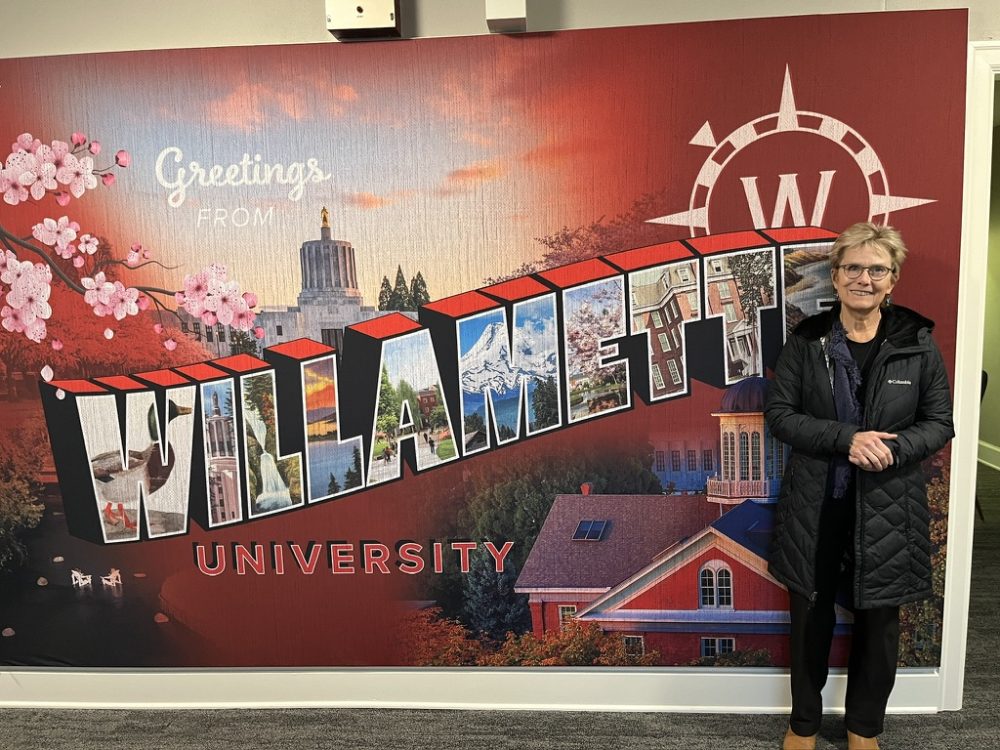

At Willamette, liberal arts meet the real world
By Karen Hott, March 2026
Fast facts for
Willamette University
Located in:
Salem, OR
Number of students:
1,620 undergraduate
Acceptance rate:
77% of applicants
Type:
Private, no religious affiliation
Test Policy:
Test Optional
This blog post is about a specific college or university, so we've included some key details right up top. These facts were last updated March 8, 2026.
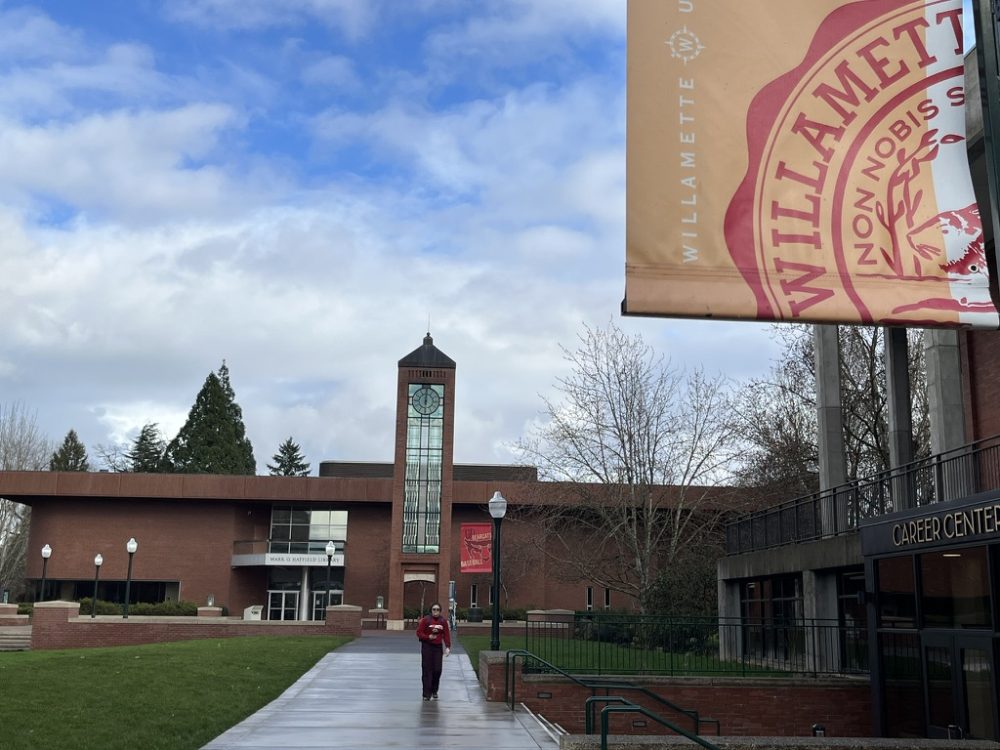
Willamette University combines a liberal arts foundation with real-world career preparation. In fact, the Salem, Oregon, school of 1620 undergraduates and 550 graduate students lies just across State Street from the Oregon State Capitol building, a mere 76 feet (they measured it) from campus. Many Willamette Bearcats have an easy commute to internships at the seat of the Oregon government in the state capital.
I visited Willamette as part of a tour of five Pacific Northwest colleges in early March 2026. The Bearcat mascot met my group of 40 counselors when we exited the bus and walked to admissions on a slightly damp but sunny afternoon.
Salem and beyond
Founded in 1842, Willamette (“pronounced Wil-AM-et, dammit,” admissions says) is the oldest university in the western United States. The region itself grew up around it, and the school educated most of Salem’s early founders and leaders. Nevertheless, 72% of students come from out of state. Salem offers plenty beyond campus, including excellent restaurants, proximity to Mount Hood and the Pacific coast, and Amtrak service to Seattle for big-city vibes.
Campus life
Mill Stream, artificially dug in the 19th century to power a mill, runs through campus and forms the setting for environmental science research and some Willamette traditions. At matriculation, each new Bearcat is given a candle to float down the stream, representing the launch of their individual journey at Willamette. Students toss friends into the stream on birthdays.
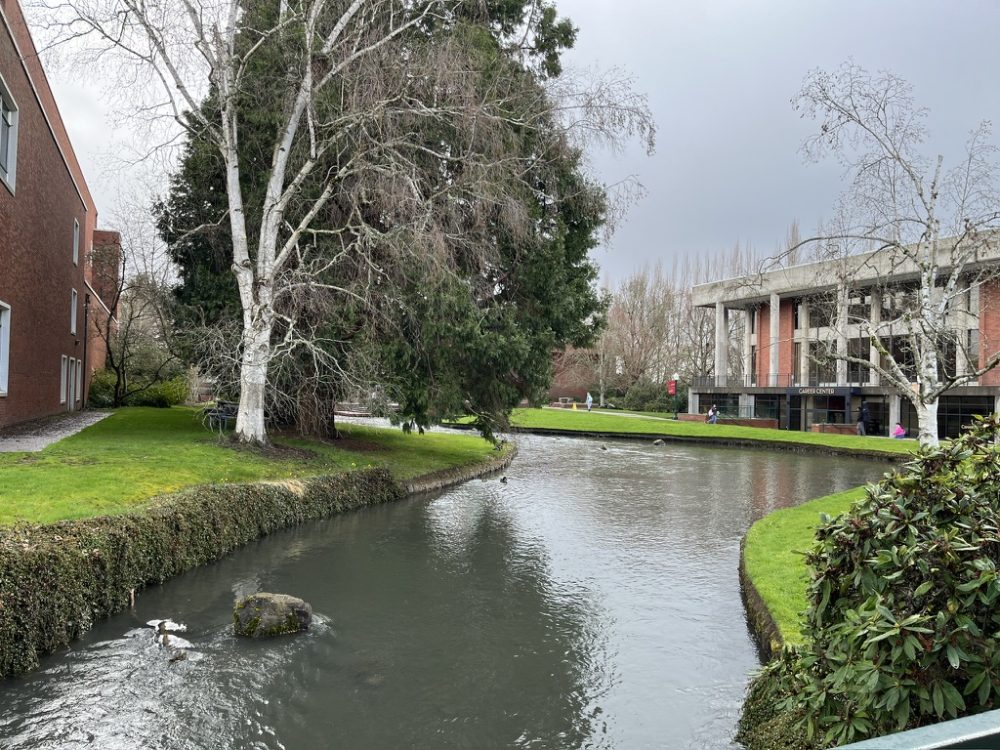
Five giant sequoias, called Star Trees for the shape formed at the top where they come together in the sky, are the setting for the Star Tree Lighting in December to kick off the holidays. These are the largest sequoias on any university campus in the U.S. You can relax there or get a bite and a coffee at the student-run Bistro, where students meet to hang out.
Academics
Liberal arts and sciences form the core of a Willamette education, with a focus on writing, listening, problem-solving, critical thinking, communication, and collaboration. These are the kinds of skills employers often say are missing from new grads, but that naturally develop with a liberal arts curriculum. You apply to the university and not a major, and you can explore broadly before declaring a major at the end of your sophomore year. Students said that Willamette is a great place to figure out the direction you want to take before declaring a major.
Willamette doesn’t have a separate honors college or honors designation within a department. They consider their curriculum to be so rigorous it’s the equivalent of an honors college education elsewhere; all students in every major engage in high-level academics. Academic support includes resources for quantitative analysis, writing, and tutoring across disciplines, as well as active advising with faculty, peers, and career counselors. Professors learn actively from colleagues in other departments because they aren’t siloed in their own fields. Willamette emphasizes experiential learning through study abroad, undergraduate research, and internships. Just across the Willamette River by car, students can take a farm class or drone class at Zena, a 305-acre property that’s half agricultural and half forest. They’re building a new teaching facility on the Zena property to accommodate the hands-on learning that occurs there in conservation and field research.
Positioning itself ahead of the curve among liberal arts colleges, Willamette offers a major and a minor in data science, something that has become more and more important in all fields. Accelerated degree programs include a 3+1 BS or BA plus a master’s in data science, a 3+2 BS/BA plus a master’s of business administration (the graduate school of management ranks in the top 100 nationally in U.S. News & World Report), and a 3+3 BS/BA and JD for law. Coming in 2026, students can major in industrial engineering, earning a four-year bachelor’s of science.
Health professions program
This newer program provides students with health profession goals with four or more years of comprehensive academic and professional support. The results have been remarkable. Before the program was in place, medical school acceptance rates were lower than the national average, but in 2025, the figure rose to 88% for M.D. programs (national average = 44.8%). The program components include individualized academic and professional support, help with career goal clarification, appropriate course selection, and interview preparation. In addition, the students at this small school have access to a cadaver lab, usually only found in medical schools.
Mergers
In 2021, Willamette merged with the Pacific Northwest College of Art (PNCA). PNCA operates as an independent college within Willamette, combining its art and design focus with the university’s liberal arts, management, and law programs. Pacific University will merge with Willamette to bring Pacific’s professional programs to the combined institution, bringing in graduate programs in occupational therapy, physical therapy, physician’s assistant, doctor of psychology, social work, education, pharmacy, and optometry. Both Pacific and Willamette will maintain their own campuses, separate admissions processes, and Division 3 athletic teams (Bearcats and Boxers).
Admissions
To apply, use the Common App, and I suggest you write the optional “Why Willamette” supplemental essay. The personal statement is considered a “very important” factor in admission, along with GPA and the rigor of your transcript. Test scores are considered if submitted, but they are optional. They look for academic rigor, strong “unassisted” writing (don’t use AI!), honest acknowledgement of any rough spots, and meaningful engagement in your community.
President Steve Thorsett
President Thorsett hosted a dinner for the counselors at his home in Salem and spoke briefly about his tenure there and his vision for the future. The mergers aren’t driven by budget or enrollment concerns; rather, he sees the expansion as a way of providing more breadth and depth for Willamette students, especially enhancing the professional pathways. With 15 years serving as president, Thorsett said that he loves the clarity of mission that is genuinely student centered; the faculty are committed to teaching quality and operate as a community of scholars. He sees Willamette’s role as connecting the liberal arts education with professional preparation, turning knowledge into action.
The motto is “Not unto ourselves alone are we born.” This encourages service and leadership.
A counselor from Baltimore asked the president what kept him up at night. Thorsett said he’s concerned about the public loss of confidence in higher education and about the financial barriers that limit access to that education. It may be hard to do much about his first worry, but a recent capital campaign raised $165 million, most of which will go to student aid. They don’t impose a fee for submitting an application.
Who will thrive here?
Willamette University is a good fit for the student who is undecided or who has broad interests, someone who wants time to explore before committing to a major. It’s great for those who crave close faculty relationships and want a collaborative, non-competitive academic culture; for those who are professionally ambitious but who value a well-rounded education; for students aspiring to health professions who want serious support. If you like the breadth of a liberal arts education but want to keep a keen eye on your future, look into Willamette.