

U. of Puget Sound broadens horizons
By Karen Hott, March 2026
“How has the University of Puget Sound changed you?” a counselor on the Pacific Northwest college tour in early March 2026 asked a student panel of five Loggers. In short, every student said they were profoundly changed by their experience at UPS. Jordan came in wanting to make a fortune in business and found that his true passion was in philosophy, politics, and government. Luna said she thought she wanted to major in psychology and discovered a love for chemistry. Rae said he knew he wanted to do something with music but didn’t know what; he appreciated having two years to figure it out. Mika and Kai discovered a love for the outdoors in addition to their career paths in STEM.
Campus and location
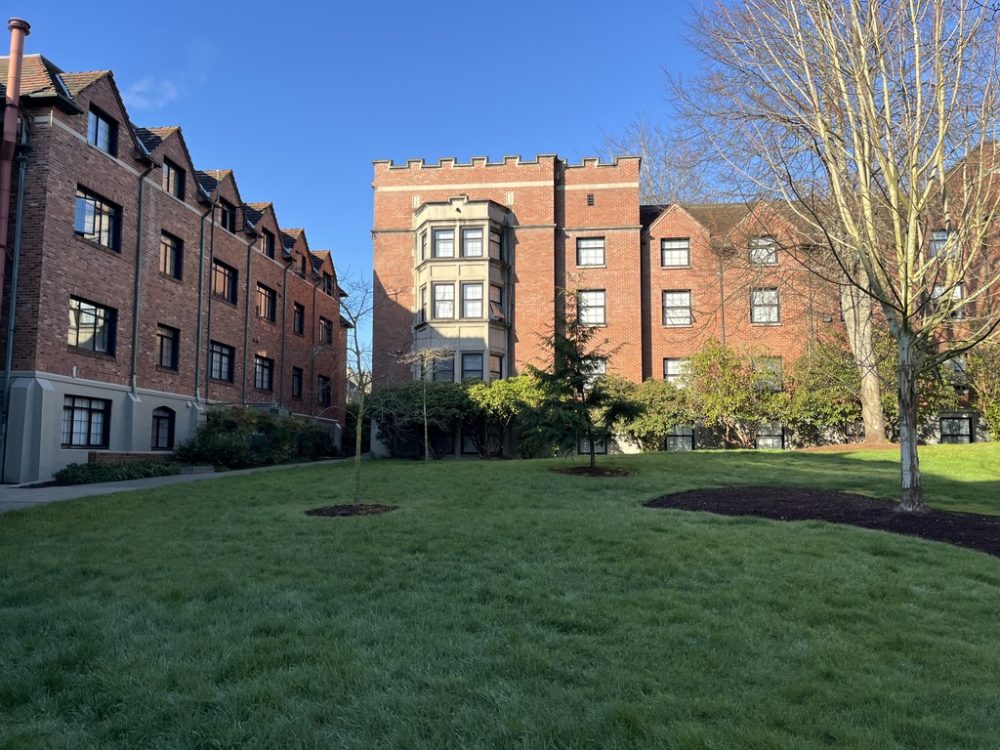
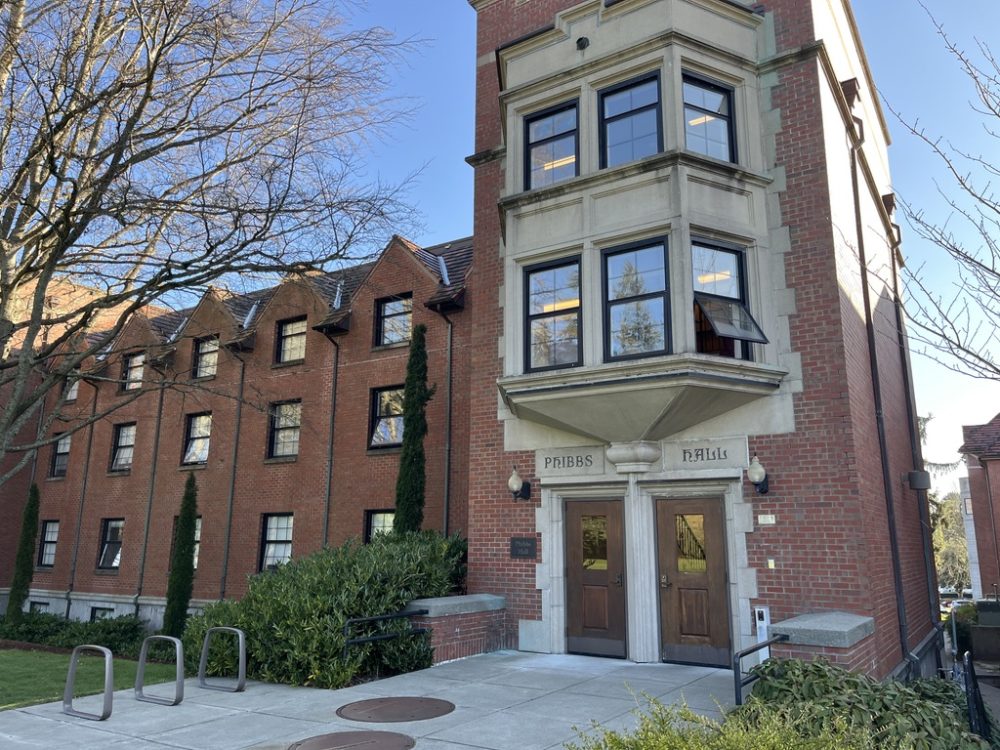
The university sits atop a hill in Tacoma, Washington, just two miles from the water of Puget Sound, a little over an hour from Mt. Rainier, and in a quaint community of homes with welcoming front porches. It’s situated on the lands of the Puyallup tribe. The academic and residential buildings, interspersed among heavy fir trees with thick dark red trunks, carry a uniform look of dappled red brick with peaks and stone arches. Even in March, healthy green grass stretched between paths. I can understand why my tour guide said that she fell in love with the campus the minute she saw it. It’s a large campus for 1,600 students, but easily navigable.
Beyond the continuity of the campus grounds, you can sense the “fruitful faculty-student interaction” mentioned in Puget Sound’s mission statement, which aims to develop in students “capacities for critical analysis, aesthetic appreciation, sound judgment, and apt expression—sustaining a lifetime of intellectual curiosity and reasoned independence.” The retention rate from freshman to sophomore year was 97% this year; it averages 88%. Seventy percent of students come from outside the Pacific Northwest. Puget Sound accepts 72% of applicants.
Academics
Puget Sound is grounded in the liberal arts, with the belief that you don’t “get” an education—you “do” your education. They reduced the number of required courses to open up room for more interdisciplinary study. The education is both broad and deep. Even business, a popular major at UPS, takes a liberal arts approach. Everyone enters UPS as “undecided,” giving you two years of exploration to figure out what you want to declare as a major.
UPS recently updated their core curriculum to include an experiential learning requirement, with a goal to “apply learning outside the classroom, build their resume, take ownership of the process, deepen self-understanding, and discover what motivates them.” Options for experiential learning include internships, study abroad, research, or community-based learning. Grants of $3,000 to $5,500 make unpaid internships or community activities more accessible. Advisers help students articulate the value of their experience, and students graduate with tangible career skills through real-world experience.
In the core, students must take required courses in Connections; Critical Conversations Seminar; Knowledge, Identity, & Power; Language; and Experiential Learning. In addition, they must take courses in each of these three divisions: Arts & Humanities, Social Science & History, and Natural Science & Math.
Signature programs
UPS offers more than 50 programs across the arts, sciences, and humanities. A few standouts:
• Business and Leadership: Study conceptual models that inform accounting, finance, law and ethics, management, and marketing; develop critical thinking, oral and written communication, problem-solving techniques, research skills, team and interpersonal skills.
• Environmental Policy and Decision-Making: Discover ways that systems thinking can address environmental problems; examine social, political, and economic contexts for decisions on environmental issues and how individual and collective decisions interact with the environment.
• International Political Economy: Identify political, economic, and social factors that shape global problems; learn to examine global issues through the lens of competing perspectives.
• Neuroscience: Learn how the brain works and links between brain and behavior; discuss ethics of neuroscience.
• Data Analytics: Learn data-related programming and communicating about data; develop broad skills in quantitative and ethical reasoning.
• Pre-Health Pathways: Open to all majors who meet necessary requirements; 3-2 program to master’s of occupational therapy; 3-3 program to doctorate of occupational therapy.
• School of Music: Merit scholarships for music are available for musicians even if they aren’t majoring in music. Majors in music earn a B.M., bachelor’s of music.
• Pacific Rim Study Abroad: This semester-long, faculty-led flagship program is led by Lotus Perry, an Asian Studies professor with 30 years at UPS.
• Honors: The honors program, a minor, involves taking five courses; honors students live together in a living-learning community and present a capstone thesis at the end of four years.
Graduate Programs
Building on the liberal arts foundation, Puget Sound offers four graduate programs:
- Occupational Therapy (OT)
- Physical Therapy (PT)
- Master of Arts in Teaching (MAT)
- M.Ed. in School Counseling or Public Health
Admissions and financial aid
Applications went up 25% this year, and their accepted students day was the largest since 2017. Puget Sound has an endowment of about $480 million and is very generous with need-based and merit aid. They will soon launch a capital campaign to fund more endowed professorships, not buildings. All students receive some form of institutional aid, and competitive merit scholarships are awarded early in the cycle.
Campus life
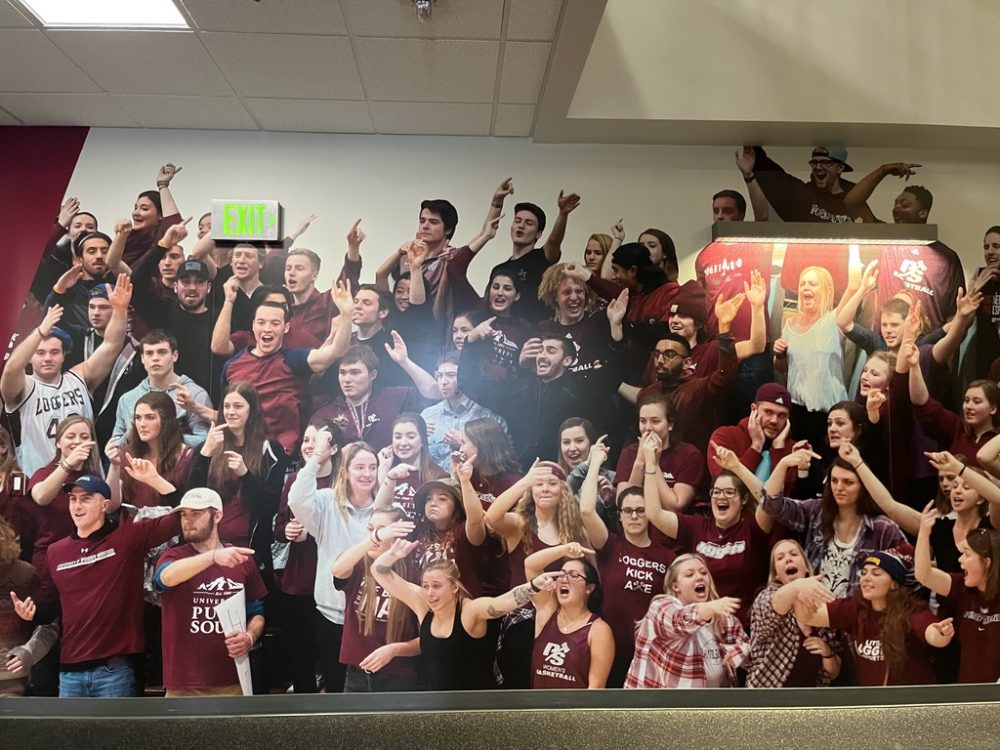
As soon as you enroll at Puget Sound, you’ll get a text and an email from your student success coach. There’s a summer bridge program for first-generation students. The football team goes in early to help freshmen on move-in day. The wellness center offers up to eight individual sessions per semester and runs groups for different identities.
Living-Learning Communities have themed housing, such as Environmental Adventure, Students of Color, and Honors. There’s one dining hall on campus with a multitude of options and an allergy-free station.
Social life
Weekend activities are frequently outdoorsy or based on traveling to Seattle. The radio station, KUPS, ranks #5 on Princeton Review’s Best College Radio Stations list. It broadcasts 24/7 to the greater Tacoma area and is run by over 120 student volunteers, covering genres from alternative and hip-hop to jazz and electronic.
Greek life comprises three fraternities and four sororities, with a formal rush in fall and an informal rush in spring. Puget Sound isn’t considered a party school. My tour guide described it as a place to “be a kid” without rushing into adulthood.
Return on investment (ROI)
College Scorecard reports that median earnings 10 years out are 30% higher than the national average. Puget Sound graduates have a 90% acceptance rate to law school. Students who worked with Health Professions Advising were accepted to medical school at 84%, compared to a national average of about 43%. Other health programs—physical therapy, occupational therapy, optometry, pharmacy, veterinary medicine, and nursing—all come in at 100% for students who worked with HPA. About half of UPS graduates go on to pursue graduate or professional school within five years of graduation, and 90% are employed or in graduate school within six months of graduation.
Who thrives at Puget Sound?
They have a saying at Puget Sound: Live like the mountain is out. My counselor group visited when the sun was shining and the fog had dissipated, so Mount Rainier was visible. Hundreds of people walked along the trail in the town of Puget Sound on this sunny day with Mount Rainier over their shoulders. If you are comfortable with liberal politics and outdoorsy types, if you want close connections with faculty and a top-notch academic experience, University of Puget Sound could be for you.