

Part 2 of 2: Applying to the U.S. Naval Academy
By Karen Hott, February 2026

Your Roadmap to the Naval Academy: A Strategic Application Guide
Planning for applying to the Naval Academy starts early. You can’t wake up senior year and just add it to your Common App.
Preparing for the Naval Academy: A Four-Year Timeline
Ninth Grade: Explore and Begin
Start early by visiting the Naval Academy and attending an admissions session to understand what makes this path unique. Assess your physical fitness level honestly and begin building a consistent fitness regimen—this isn’t something you can cram for senior year. Consider attending the USNA Summer STEM camp, which welcomes rising freshmen and throughout high school. This is the time to explore.
Tenth Grade: Plan Strategically
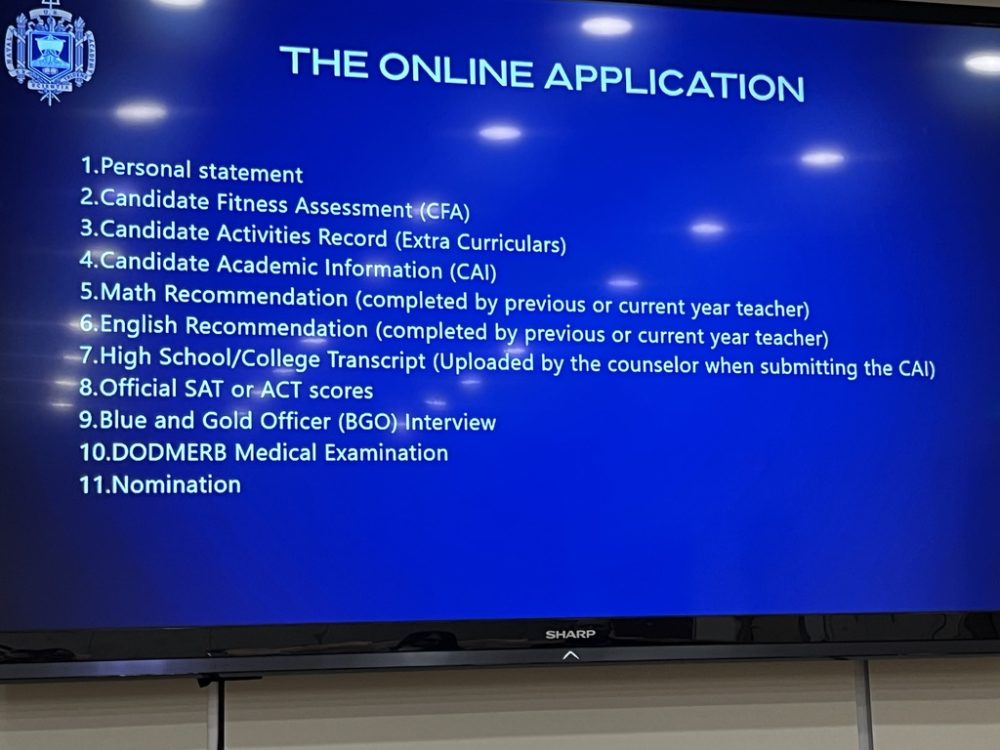
Familiarize yourself with the application requirements (I cover these below). Choose your junior year courses by prioritizing rigor without overwhelming yourself. Be aware that junior year math and English teachers usually write your teacher recommendations. Continue your physical fitness training and consider returning to Summer STEM.
Eleventh Grade: Step Up
Junior year is intense. You want to take the most rigorous courses you can while maintaining strong grades. Focus on depth over breadth in your extracurricular activities. By junior year, you should be demonstrating commitment and leadership in school, sports, or community activities, not just participation. Apply to the USNA Summer Seminar, which serves as both an introduction to Naval Academy life and a preliminary application step. Research your congressional representatives and senators to understand their nomination processes and timelines. Request your teacher recommendations in the spring. Begin preparing for the Candidate Fitness Assessment (CFA). Watch for the opening of the USNA application in spring or summer, and start your application.
Senior Year: It gets real.
Complete the application thoroughly. Apply for nominations from your member of Congress, both senators, and any other sources for which you’re eligible. Complete the CFA and DoDMERB medical examination. Stay in close contact with your Blue and Gold Officer (BGO), your regional representative who will interview you and support your application. You’re going to have a very busy summer and fall.
Additional Recommendations:
- Build relationships with teachers early: Don’t wait until junior year to form real relationships with your math and English teachers.
- Document your leadership: Keep a running record of leadership positions, responsibilities, and accomplishments.
- Start fitness training seriously: The CFA includes events like pull-ups, push-ups, sit-ups, a basketball throw, shuttle run, and mile run. These require consistent preparation.
- Understand the timeline: Service academy applications have earlier deadlines than most colleges. The whole process is typically completed by December 31 of senior year.
- Have a backup plan: Even outstanding candidates may not receive an appointment. Consider NROTC scholarships and applying to other colleges.
The Four Qualification Components
To qualify for USNA, you must satisfy four components of the application. Less than 10 percent of applicants get accepted, so the Academy is one of the most selective institutions in the world. You must be qualified in all four areas to receive an appointment.
Academic Qualification (Admissions Board Qualified)
- Personal Statement: Focus on resilience, leadership, and your desire to serve the country.
- Candidate Activities Record: Explain your extracurricular activities.
- Candidate Academic Information (CAI): Your guidance counselor will complete this. It’s similar to the school record or school profile to give context to your transcript.
- Math Recommendation: This will be completed by your previous or current year math teacher.
- English Recommendation: This will be completed by your previous or current year English teacher.
- SAT/ACT Scores: Official scores will be superscored; the CLT will also be accepted in 2027. For the ACT, the range is 24 to 31, for SAT, 1200 to 1420.
- High School Transcript: Your counselor will upload this with the CAI.
- Blue & Gold Officer Interview: Your regional representative will conduct a formal interview.
Physical Qualification
The Candidate Fitness Assessment (CFA) is a battery of tests incorporating a basketball throw, pull-ups, push-ups, sit-ups, a 40-yard shuttle run, and a one-mile run. Any of the following can administer the CFA: physical education teachers, active duty commissioned officers, Blue and Gold officers, team coaches, JROTC instructors, or USNA admissions staff.
Medical Qualification
Do this as early in the application process as possible. It’s managed by DoDMERB (Department of Defense Medical Examination Review Board). Once you open and show progress towards completing your USNA application, admissions will send your name to DoDMERB, and DoDMERB will reach out via email with instructions for a medical exam.
Note that candidates on medication may be disqualified; you should be off of all medication 12 to 24 months before applying. However, don’t automatically rule yourself out if you’re on medication. Many people receive waivers for this.
Nomination
Candidates must obtain at least one nomination from a U.S. Senator or Representative. Find out who your two senators are and who represents your U.S. Congressional district. Then check their websites to find out what deadline that legislator has set and what they ask for. Some require interviews; most want one or more essay responses. This varies from person to person, so start this process early. You can and should apply to more than one nomination source for the best chances. For information about service academy nominations, see https://www.usna.edu/Admissions/Apply/Nomination-Sources.php
Can you have a learning disorder and be accepted to the Naval Academy? According to Chris McMunn, a candidate’s medical status is not considered by the Admissions Board, so a learning disorder or any disqualifying medical condition would not prevent them from being accepted; however, they would then need to receive a medical waiver in order to be fully qualified and enroll at USNA. The medical waiver review would be specific to the candidate, so it’s possible a waiver could be granted for some learning disorders on a case-by-case basis depending upon many factors, including if they use medication, have an IEP or use testing accommodations at school or for standardized tests. No testing accommodations or IEPs are offered to midshipmen while they’re attending USNA.
If you go on to graduate school or medical school, you will owe the Navy additional years of service, said McMunn. The additional years of obligated service can vary by graduate school program, but it’s typically a 2:1 ratio or two years of additional service for every year of additional education or training. The Medical Corps is slightly different, but still varies depending if they are attending a civilian or military medical school, and is typically an additional five to seven years of obligated service after they complete their medical residency training.
Is the U.S. Naval Academy for You?
Before you dive into this demanding application process, revisit those four essential questions from Part I: Can you thrive in this highly structured environment? Do you value leadership over flexibility? Are you ready for the commitment? And most importantly—are you called to serve? If your answers are still yes, then it’s time to get started.

What if you’re not accepted?
The Naval Academy accepts less than 10% of applicants. If you don’t receive an appointment, you have several options: the Naval Academy Preparatory School (NAPS) for invited candidates, NROTC scholarships at civilian universities, or reapplying the following year after strengthening your application. Many successful midshipmen didn’t get in on their first try.
Most importantly, you need to start thinking about the Naval Academy early in your high school career. Learn all you can and be aware of the many components of a successful application.