

Naval Academy not for those who need structure
By Karen Hott, February 2026
Fast facts for
U.S. Naval Academy
Located in:
Annapolis, Maryland
Number of students:
4,500 undergraduate
Acceptance rate:
9% of applicants
Type:
Public
Test Policy:
SAT or ACT Required
This blog post is about a specific college or university, so we've included some key details right up top. These facts were last updated February 15, 2026.
It’s for those who love structure and serving the country.

USNA: Part 1 of 2
It’s as prestigious as MIT, on par with the Ivies as the #3 best liberal arts college in the U.S., and it provides a free education worth hundreds of thousands of dollars, but that’s not what makes the U.S. Naval Academy in Annapolis, Maryland, special. What distinguishes this college from any other? It’s the full-hearted commitment these midshipmen make to serving their country.
I spent a frigid Saturday in January with a couple of other brave counselors who ventured out to spend the morning with Chris McMunn, assistant director of strategic outreach at the Naval Academy. After a 90-minute info session and a very cold tour of the Yard, we dined with four delightful midshipmen, two young women and two young men who were 100% there to serve their country. They told me the five-year commitment you must make to the Navy after leaving the Academy didn’t faze them at all because the military is the life they want to lead.
If you’re accepted to the Naval Academy, you receive a scholarship covering the full cost of attendance, plus a $1,400 a month stipend to cover personal expenses. Your expenses, however, are low enough that you can start socking away money for an IRA or a Corvette.
Is the Naval Academy Right for YOU?
The Naval Academy is structured, but it’s not for students who need structure. It’s for students who love the military and its order, students who are self-motivated and independent. You must be academically strong but resilient enough to work hard for a B. Though you don’t have to play a sport, you must be physically fit and able to pass the fitness test every semester. Most importantly, you must be genuinely passionate about serving the country.
If you find yourself in over your head your first or second year at USNA, you can leave without penalty, but at the end of sophomore year, you sign a scroll committing yourself to service. You will have a minimum of five years of service after graduating as an ensign in the Navy or a second lieutenant in the Marine Corp. Pilots must make an eight-year commitment. USNA sends as many students to flight training as the Air Force Academy does.
About a third of midshipmen do not attend directly from high school, so many of them come in with credits from other institutions. But the Academy doesn’t accept transfer credits. Everyone welcomed into the academy must take the full four-year curriculum. (Surprisingly, the same is true for St. John’s College, USNA’s neighbor.) You must be 17 to 22 years old on your start date, July 1. The schedule is the same each day and for each cohort, starting at 5:30 a.m. and ending with lights out at 11 p.m.
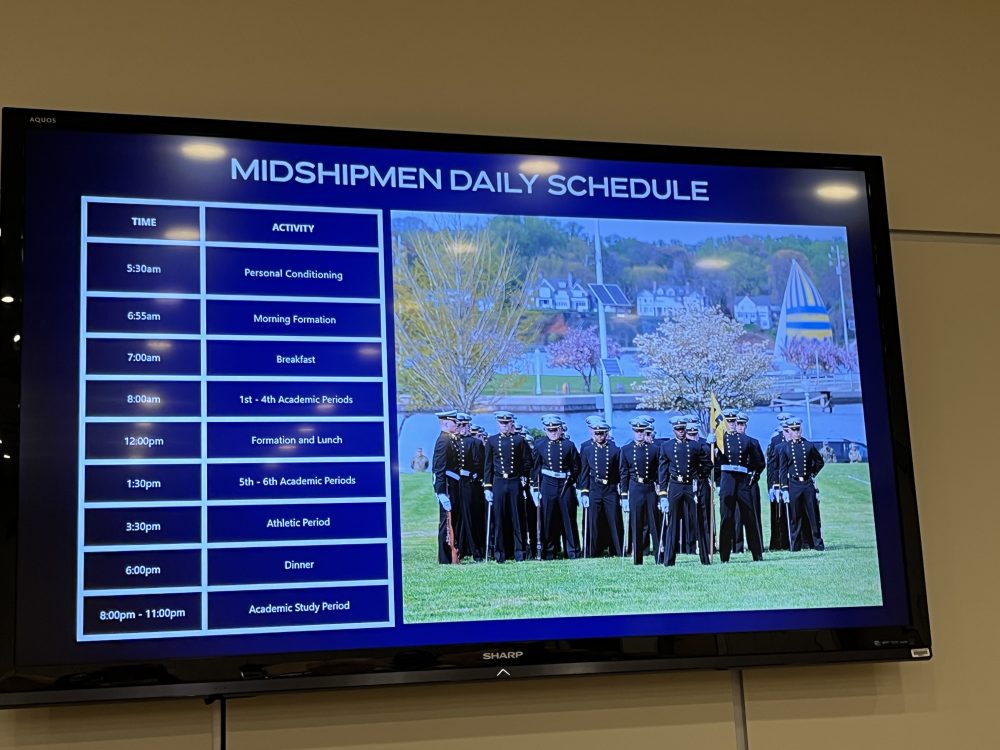
College at the USNA differs significantly from a traditional college experience. See www.usna.edu.
| Element | USNA | Traditional College |
| schedule | fixed, inflexible, little free time | flexible, significant variation, lots of free time |
| culture | military | civilian |
| development | leadership, academic | personal, academic |
| career | 5-year service commitment; guaranteed career | career flexibility; no guaranteed career |
Academic Excellence
You can major in English at the Academy, considered a liberal arts college, but you’ll still earn a Bachelor of Science degree, backed up with a core curriculum that includes three years of calculus, two years of physics, and courses in navigation. There are 23 majors across three schools: Engineering & Weapons, Mathematics & Science, and Humanities & Social Sciences. Engineering ranks among the top tier of colleges, #5 in the 2025-26 U.S. News and World Report. Partnerships with the University of Maryland, Johns Hopkins, and George Washington University enable midshipmen to obtain a master’s degree.
Class sizes run from 10 to 25 students, and the student-to-faculty ratio is 8:1, with half the faculty military, half civilian.

Life at the Yard
The Yard (as in “shipyard”) boasts 22 world-class athletic facilities as well as comprehensive support services. The Navy covers your medical and dental expenses, and you can not only get your hair cut and laundry done, there’s a cobbler to repair your shoes (make sure to keep them shined).
Annapolis, as a quintessential college town, has a lot to offer that you won’t find at Colorado Springs (Air Force) or West Point (Army). Besides the allure of Annapolis, it’s within an hour of both Washington, D.C., and Baltimore. Many Naval Academy grads return to Annapolis when they retire.

USNA plays 36 NCAA Division I sports, including varsity football, men’s and women’s basketball, lacrosse, and swimming, women’s volleyball, and co-ed sailing. In addition, the Midshipmen Action Group performs 20,000 hours of service annually, and there are plenty of student clubs, club and intramural sports, and activities. The two midshipmen I spoke to at lunch were varsity athletes who moved from DI to intramurals because the time commitment on varsity left them no spare time in their schedules.
Whether you’re competing at Division I or exploring Annapolis on a Saturday afternoon, every aspect of life at the Academy revolves around one central truth: The U.S. Naval Academy delivers a first-class education in exchange for a commitment. It’s a phenomenal deal if your heart beats red, white, and blue.
Look for Part II to drop next, when I’ll be covering everything you need to know about USNA admissions.